
Day 14: Grey Areas and Difficult Decisions
“Whatever is my right as a man is also the right of another; and it becomes my duty to guarantee as well as to possess.” ― Thomas Paine
As much as I love it when Dr. Epright comes and discusses ethics with us I always find these lectures the most frustrating in every tier.

Dr. Epright during our last lecture of the day on ethics.
The issue is never with the actual topics themselves but I can say for sure that I have a bias for certain sides (*cough* vaccines *cough*) and try as I might to be open minded about other people's opinions when the scientific evidence is there I don't understand how you can dispute it. I know that this is an issue that every doctor eventually encounters with a patient but its an interaction I can say that I'll have to learn how to handle now for future reference.
Even though the ethics lectures took up a large chunk of our day they weren't the only activities planned. Dr. Catalana somehow made me both anxious and less stressed during his admissions discussion. I just cannot wait to have my AMCAS application out of the way once and for all. Right now it just feels as if I'm running downhill trying not to trip and fall before I get to the bottom of it but this to shall pass.
Afterwards we were then split up into small research groups on different fields of medicine. My consisted of a job I had never heard of before: Naturopathic Medicine (ND). At first it peaked my interest because it says that they focus more on primary care. ND's also specialize in administering and dispensing natural medicines such as herbs, botanical extracts, vitamins, and more. As someone who tries to stay away from medications when I can this side of ND appealed to me but once my group delved a little deeper into the topic I was not as impressed. The career outlook is on the rise due to a provision in the ACA but, to put it lightly as one ex-ND stated, “Naturopathic medical care is like picking treatments out of a magical hat.” All of the testing to become an ND is internally regulated, unlike MD/DO programs, and there are several statistics that seem a little fishy as well... Maybe all of the websites we stumbled upon were just biased but after reading what I have I don't think I'll be going to see an ND anytime soon.
***DISCLAIMER: What you are about to see is someone relating what they think they grasped in a philosophical / ethics lecture. Aka I tried to understand and here are my notes of what I was able to grasp.
We were given a brief overview of the Great Debates groups that we would be participating with Tier 2 and a lot of the information I remember from being in the tier itself as well as discussions we had with Dr. Epright in Tier 3. The afternoon lectures, however, were something very new to me. The only philosophy class that I've ever taken I dropped the first day after not being able to understand a word the tiny German professor was saying in the small basement classroom. I doubted that the experience would be anything similar with Dr. Epright. Her lecture mostly consisted of two schools of thought that conflict in ethics: consequentialism and deontology. The later is based in the school of thought that autonomy is an absolute good while the former is an umbrella theory where good, bad, right, and wrong are determined by the resultant consequences of the actions. From what I understood, consequentialism in medicine takes a utilitarian approach where the best option relates to the greatest good for the greatest number of people (such as healthcare being a right and not a privilege). Dr. Epright gave fantastic examples and Im sure that her lecture will come back to help us with the Great Debates but I do hope that she comes back to the topics at another time.
Last but not least Mrs. Cynthia Trout came to talk to us about the importance of communication within healthcare. It was interesting to see the difference as to what the doctors and nurses thought were great communication within the healthcare team but the examples Mrs. Trout gave when clear communication on patient treatment was not practiced will definitely be in the back of my mind for years to come. Overlooking something or making a mistake is something Im most nervous about when entering medicine but it will be inevitable in the long wrong (hopefully not too often though, that would be tragic). All I can say is I'll just have to remember the example of narration of care in Days of Thunder and I should be all good to go!
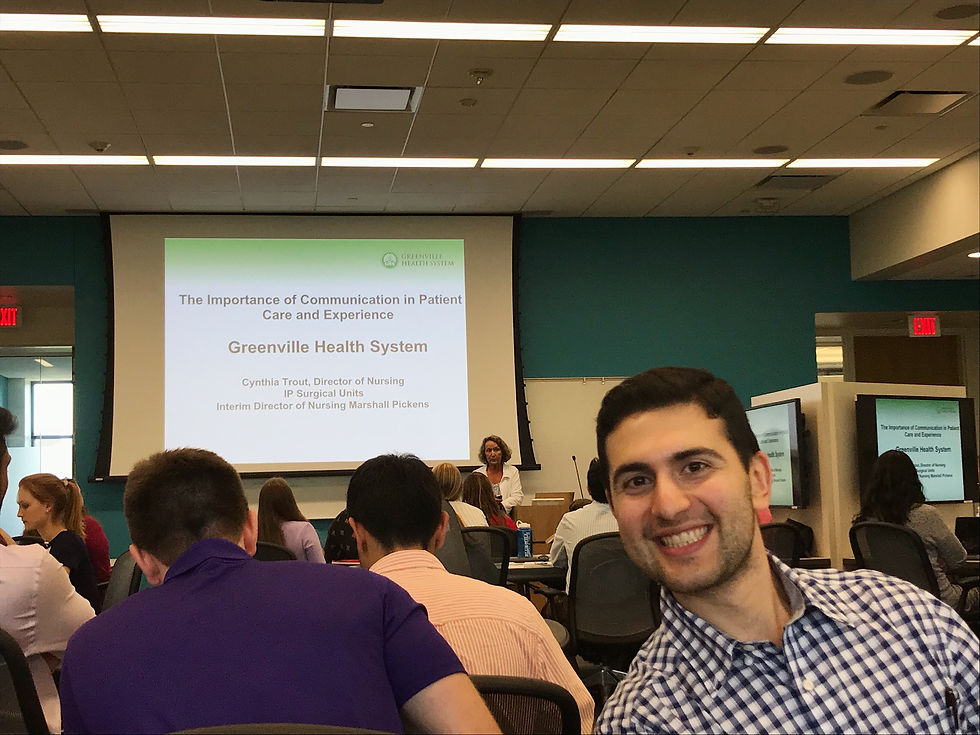
Cheese!
Comments