University of South Carolina
The Future of Personalized Medicine
Key Insight #1
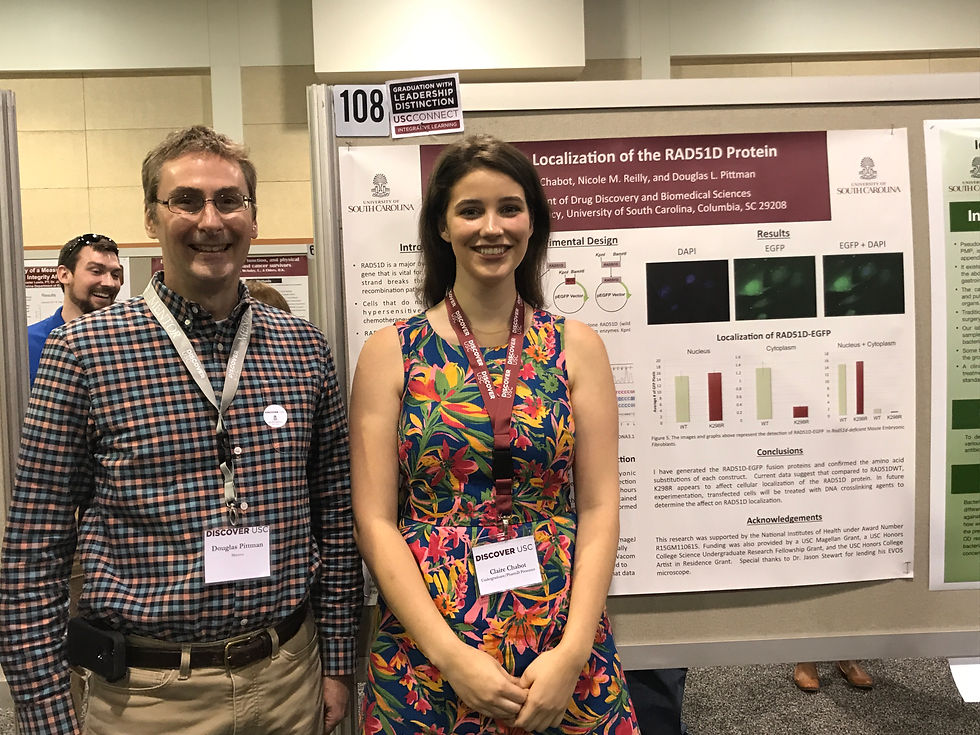
My research advisor, Dr. Doug Pittman, and I standing infront of my poster presentation at Discover USC 2018. I won 2nd place in Biological and Biomedical Sciences for this presentation.
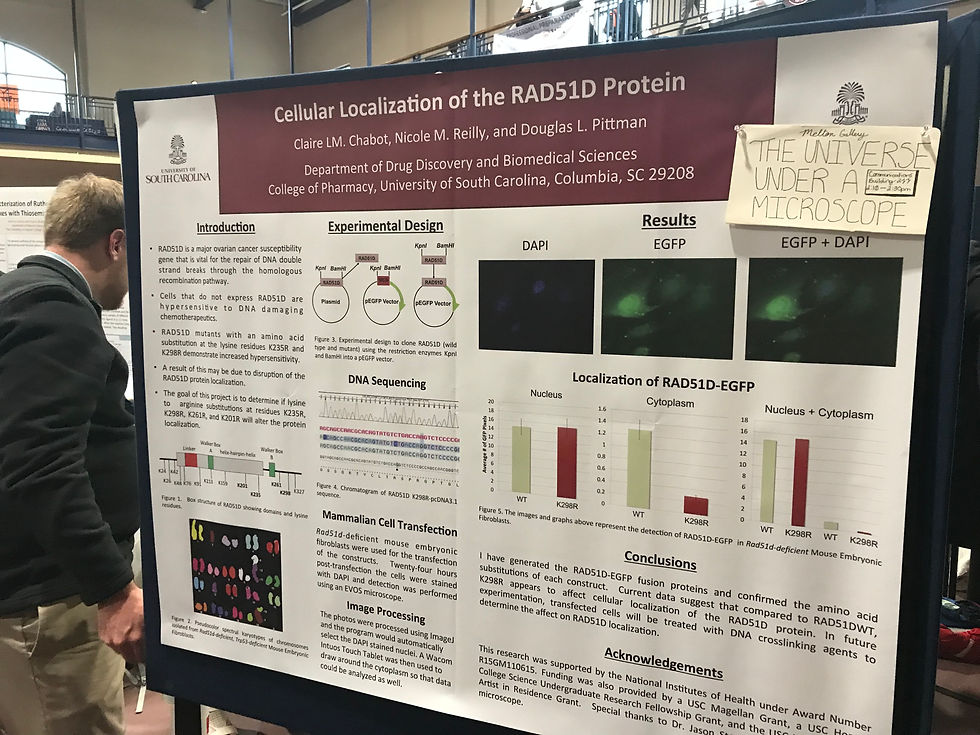
This is my poster that I presented at the National Conference of Undergraduate Research 2018 in Oklahoma.
My research advisor, Dr. Doug Pittman, and I standing infront of my poster presentation at Discover USC 2018. I won 2nd place in Biological and Biomedical Sciences for this presentation.
Recent statistics are grim: there are 12.3 new cases of ovarian cancer per 100,000 women per year, and 7.9 of these cases will result in death. Risk for ovarian cancer, along with many other cancers, is increased if a patient has a mutation in certain genes, especially the DNA repair genes RAD51D, BRCA1, and BRCA2. Studies show that at least fifty percent of patients with high-grade serous ovarian cancer have mutations in DNA repair genes.
If all of this data comes as a shock to you it did as well to me freshman year, when I joined the Pittman Laboratory. The time I have spent researching the ovarian cancer susceptibility gene rad51D has led me down the exciting path to discover the benefits of personalized medicine, which is an innovative form of treatment curating pharmacotherapies to a patient’s DNA. This subject utterly fascinates me; customizing treatment plans for patients based on their genetics and delivering them with better efficiency is revolutionary. Treating patients in this way has the potential of increasing cancer survival rates, decreasing hospitalization times, as well as diminishing the side effects a patient may experience. Personalized medicine is the future of healthcare, especially when it comes to treating such a deadly disease as ovarian cancer--where optimal treatment is necessary for survival in a short amount of time. As an undergraduate researcher I was not only able to observe, explore, and present these findings, but also to discover my hidden passion for the subject. In the future, I hope to one day incorporate this form of treatment into my own medical practice.
The past few years in this atmosphere have allowed me to develop my own project on the localization of the RAD51D ovarian cancer susceptibility gene. Not only that, but throughout the process I have also developed new lab techniques to analyze data, train new undergraduate, graduate, and pharmacy students as well as work on multiple projects to collect data for a research paper. I will also be publishing in March 2019 an article in Caravel and have already been published a paper in Carolina Crosstalk about my experiences and work in undergraduate research. Dr. Pittman’s laboratory is an environment where students are encouraged to be independent and expand their knowledge on the science of genetics and ovarian cancer. My poster on my research at Discover USC 2018 also won second place in the Biological Sciences which displayed my research findings on Rad51D cellular localization. As for the importance of the work conducted in the laboratory, one in seventy-three women will develop ovarian cancer and many of their tumors will have mutations in known DNA repair genes such as rad51D. It is crucial to study this phenomenon, but it is also important that this information is able to reach a broad range of people.
I have also had the opportunity to take my undergraduate research in Dr. Pittman’s laboratory for undergraduate credit as Chemistry 496: Genetic Instability and Ovarian Cancer. Taking this course added another layer to my research experience. Not only was I working on my personal research project, Dr. Pittman and I would have weekly one-on-one discussions about the progress of my research, along with other current topics in the field of genomics. This extra experience also gave me the opportunity to impart my own research knowledge to new students; I began training graduate students, pharmacy students, and undergraduate students in laboratory cloning techniques. This additional time in the laboratory also provided me with the data and time to apply for my own research grants. Overall, I have been awarded $6,250 through the Magellan Grant, the SURF grant, and the Artist in Residence Project to fund my research. Currently, I am also in the process of applying for an addition $25,000 from the Honors College to fund the rest of my senior thesis. Overall, I cannot say that I will make any ground breaking discoveries while researching in the Pittman Laboratory; nevertheless, I can say that I have contributed to the future of personalized medicine. Research into ovarian cancer is certainly not in its infancy; it still has a long way to go, but my experiences have allowed me to delve deeper into personalized medicine. I know now that my time in Dr. Pittman’s research laboratory has cemented my desire to study this subject in the future as a physician.